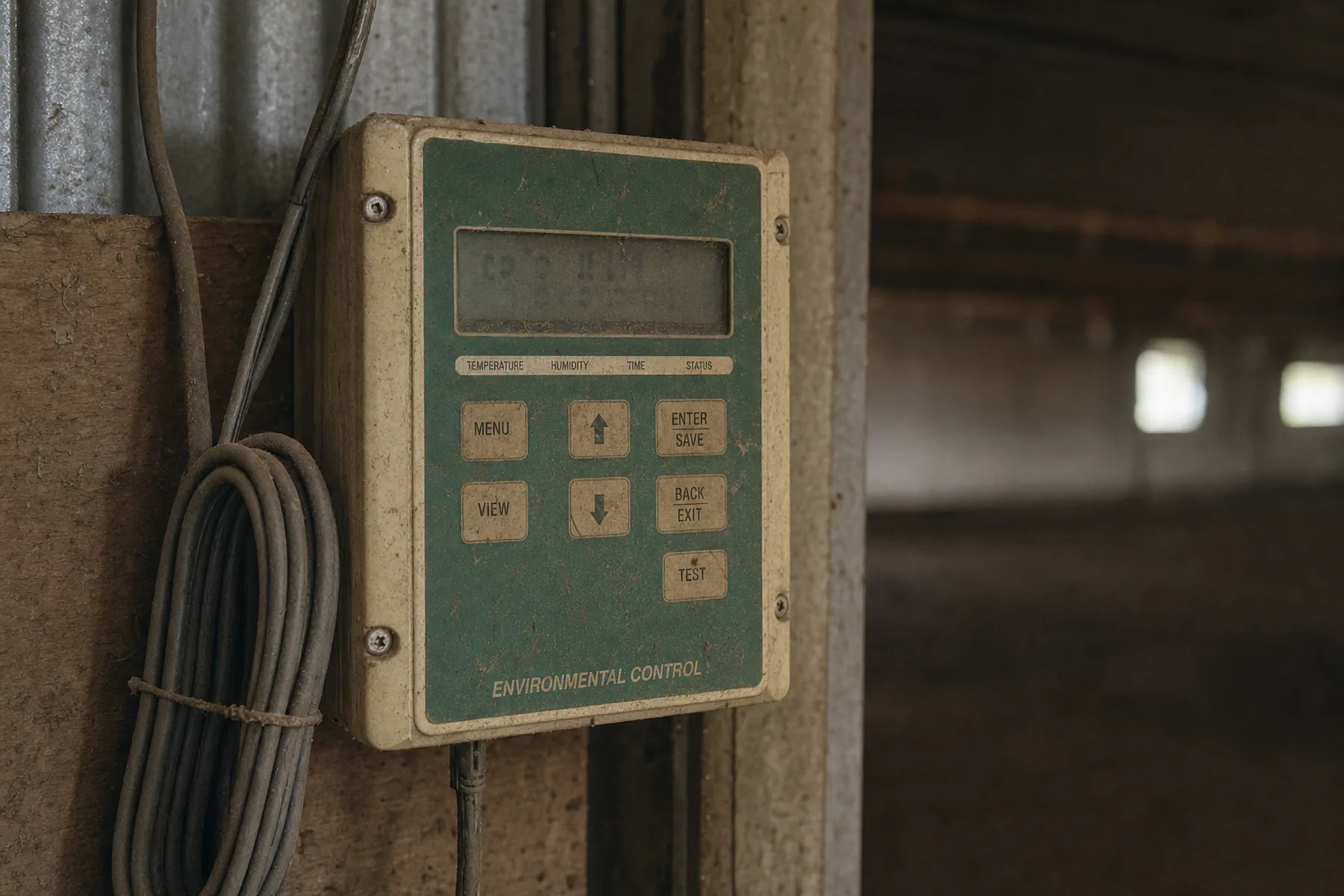
Our real competitor is a wall-mounted controllerand a service rep with a phone.
An honest account of who else is in this market, what they charge, what has already failed here, and where that leaves a company our size.
Most competitive pages are written to make the writer look inevitable. This one is written because we needed the answer ourselves, and because a grower reading our site deserves to know we understand what they already have. Two conclusions surprised us. The first is that the software category we are entering has a poor commercial track record. The second is that the largest consolidated player in it is currently for sale.
Not a software product. An installed base and a relationship.
The question a grower asks is not “which software”. It is “why would I use anything other than what is already on the wall.”
Eighty-four percent of US broiler houses had integrated electronic controls by 2011. Those controllers are competent at what they do: they hold the current reading and they sound an alarm when a value crosses a threshold. Alongside them sits the integrator’s field service representative, who visits, looks at the birds, and knows the farm.
That pair — threshold alarm plus experienced human — is the substitute we are actually measured against. It is much stronger than a feature comparison suggests. Its weakness is specific and narrow: neither the controller nor the weekly visit reads a slow multi-day drift in a number that is still inside its acceptable band. That is the only opening worth claiming, and claiming more than that would be dishonest.
Integrator grower portals are not doing this job.
We expected to find that the major integrators had already built analytics into their grower apps, which would have closed the opportunity before we started. We went and looked at each one. They have not. The apps that exist are notification and settlement tools, and for several large integrators we could find no grower app at all.
| Integrator | Grower app | What it actually does |
|---|---|---|
| Tyson Foods | Farmer Connect | Notification only, per its own store listing — App Store |
| Mountaire Farms | Prime Quality | A Bushel-powered grain portal, not a broiler house tool — Mountaire |
| Perdue Farms | Grower app | News and announcements dashboard |
| Pilgrim’s Pride | none found | No published grower-facing application |
| Wayne-Sanderson Farms | none found | No published grower-facing application |
| Koch Foods | none found | No published grower-facing application |
This cuts both ways. It means the analytics layer is genuinely unbuilt. It also means an integrator could build it, bundle it, and give it away, and no grower would pay us for it afterwards. We treat that as the primary strategic risk to this business rather than as an argument in our favour.
The largest consolidated player put the whole business up for sale thirteen days after buying a competitor.
Munters had spent years assembling the most complete poultry controls and software portfolio in the industry: MTech and Amino, Rotem, InoBram, Hotraco, AEI, and the Speria brand, with roughly 45,000 controllers in its installed base and MSEK 1,753 in 2025 net sales for the FoodTech area. On 3 June 2026 it acquired Optifarm, a UK poultry-house software company. On 16 June 2026 it announced it was exploring divestment of the entire FoodTech business area, with Evercore advising.
We are not going to pretend to know what that means. Two readings are available and both are plausible: either poultry controls are a strong standalone asset that fits someone else’s portfolio better, or the software layer on top of controls has not produced the returns the acquisition thesis assumed. What is not in dispute is that the market’s consolidator has stopped consolidating.
The practical consequence for us is that we are not entering a settled market. We are entering one whose largest participant is in play.
Two published prices exist in this entire category.
We looked for a price list from every vendor we could identify. We found two. Everything else is quote-on-request, which tells you the category still sells through a sales conversation rather than a page.
| Vendor | Published price | Model |
|---|---|---|
| FlockSense | $149 / month | Per live flock — flocksense.ai |
| Intelia | CAD 3,000–6,000 | Per building, plus CAD 50–100 / month |
| All other vendors identified | not published | Quote on request |
Those two points bracket the market meaningfully. One is pure software at a subscription a grower can decide on alone. The other carries a hardware installation that requires capital approval and, in a contract-grower context, often a conversation with the integrator. We have chosen the first shape, and the reason is not margin — it is that a $149-scale monthly decision is one a grower can make without asking permission.
What has already been tried here, and how it ended.
This is the part of the research we would have preferred not to find, and it is the reason our own plan is deliberately small.
Pitik — $59M raised, revenue to zero
An Indonesian poultry technology company that raised roughly $59 million and, by the account of its own post-mortem coverage, wound down to no revenue. The failure was not the technology. It was the business model wrapped around it. The Runway
Tibot — killed partly by avian influenza
The French poultry-house robotics company cited COVID, supply chain disruption, the war in Ukraine, and avian influenza in its collapse. That last one deserves attention from anyone in this sector. We would instinctively describe an outbreak as a tailwind for early-warning technology. For Tibot it was demand destruction: barns emptied, capital projects stopped, and nobody buys equipment for a house with no birds in it. Disease pressure is not automatically a market.
Optifarm — roughly £970k a year of losses on free-to-join pricing
Optifarm ran a free-to-join, pay-per-insight model and was losing on the order of £970,000 annually before its trade sale to Munters. It is the closest published analogue to a software-only poultry insight product, and its pricing model did not fund the business.
SENTINL — no verifiable corporate substance
A brand present in search results with no published company detail; its site leaks a placeholder hosting account. We list it because a market map that only includes real companies overstates how crowded this space is, and one that includes brand names without checking them overstates it differently.
What this research changed about our plan.
Three things, concretely.
We stopped describing this as an underserved market. It is a market where several funded attempts have failed and where a large consolidated portfolio is being shopped. The unbuilt analytics layer is real, but its being unbuilt is evidence about difficulty as much as about opportunity.
We will not sell hardware. Not because sensors are unnecessary — the houses already have them — but because the failures above cluster around capital-intensive, install-dependent models with long sales cycles and biosecurity friction. Software on top of data a grower already records is the version of this business that can survive being small.
We measure before we sell. Sixty-one percent of surveyed growers said they need to see a technology working on a farm first, and there is no published figure for what earlier detection is worth. Those two facts point to the same first step, which is a validation study rather than a launch.
What would tell us we are wrong
If a major integrator ships a competent analytics layer inside its grower portal, this business does not work — distribution and free beat a better product. If our validation study finds no useful lead time in manual daily records, the premise fails on its own terms. We would rather find either out in a study than after selling subscriptions.
References.
- Munters. Munters to explore a potential divestment of its FoodTech business area, 16 June 2026. munters.com
- Protein Signals. Munters acquires Optifarm. proteinsignals.com
- FlockSense. Pricing. flocksense.ai
- Tyson Foods. Farmer Connect application listing. apps.apple.com
- Mountaire Farms. Introducing Prime Quality farmer portal and app. mountaire.com
- The Runway. Pitik post-mortem. therunway.ventures
- USDA Economic Research Service, EIB-126, 2011 ARMS — installed controller base. ers.usda.gov
If we have mischaracterized your product, tell us.
This page is built from published material only. If you work at one of these companies and something here is wrong or out of date, we will correct it.